A Creative Practice Promotes Brain Health in the Aging Brain
How a recreational activity can re-create health

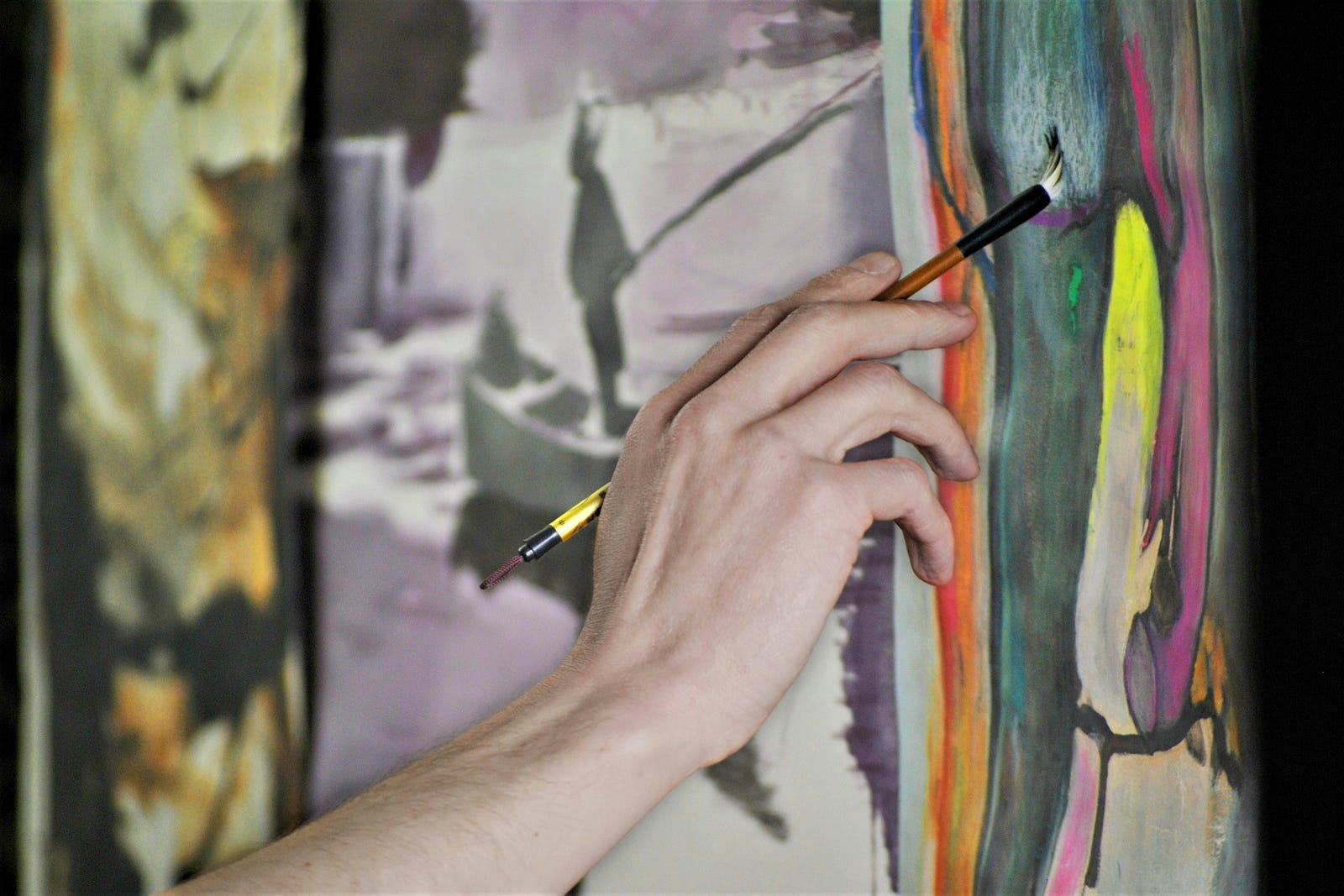
Dad was a quintessential DIY project guy. He was an electrician by trade, but he was willing to learn how to do anything that required sweat equity and a few rough supplies. He painted our house, put in flooring, hung cabinets, repaired the plumbing. He built a shed, a dock, and a deck. He decorated cakes, quilted with my mom and her friends, and gardened. He was always doing something.
Mom joked that he never finished a project because he believed that as long as he had a project going, he would keep on living.
So when Alzheimer’s disease and Lewy Body dementia took away the function of so many parts of him, he was unable to access one of his most life-giving attributes: his creativity.
For several years at the end of his life, we had the opportunity to take care of him and of mom. Though he had very limited mobility, I could see in him the itch to make something.
And so, we painted.
I drew mandalas, simple, symmetrical geometric shapes, that we could paint together.
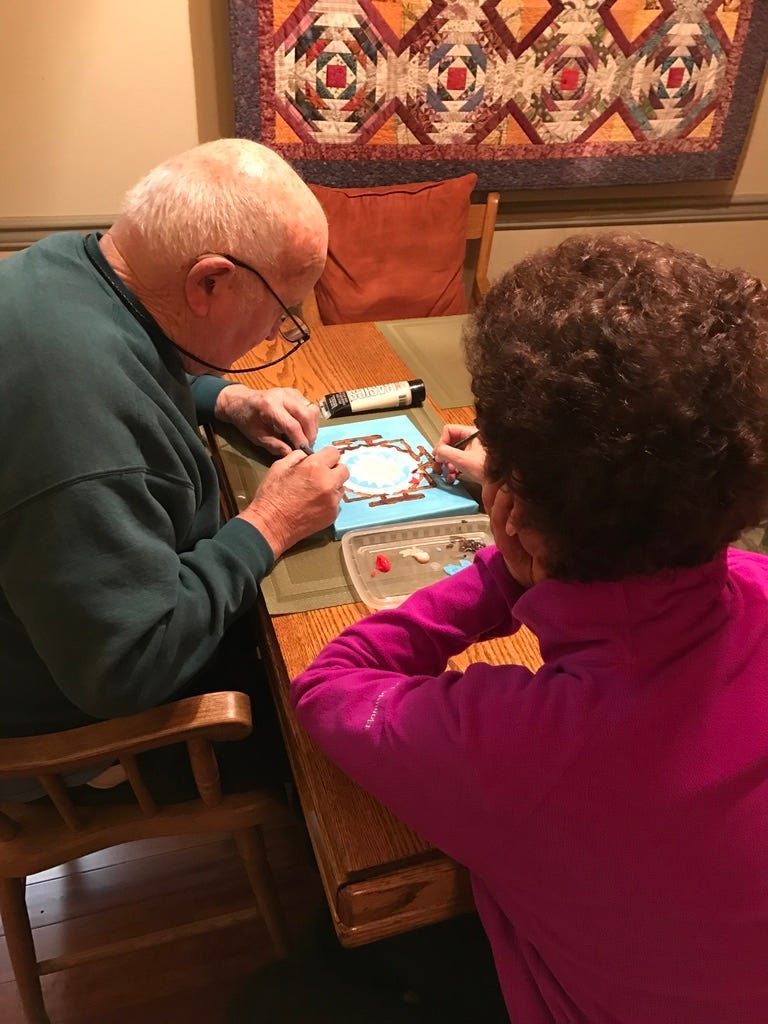
When we began, he would adjust his glasses, focus, and immerse himself in the project at hand. Together we sat and painted bright reds, blues, golds, watching pleasing patterns emerge. While he was painting, he was calm, centered, and fully engaged.
Dealing with the agitation that accompanied my dad’s Alzheimer’s was challenging. Doing something “creative” helped his state.
In addition to painting, we baked.
Before he was trained to be an electrician, Dad worked in the bakery of a resort in the Catskills Mountains. Up at 4:00 a.m., he started the sweet loaves of Challah bread and mixed the dough for the fruit blintzes of the day. Even though his career changed, he maintained his baking skills throughout his lifetime, teaming up with Mom to make breads and cakes to celebrate family occasions.
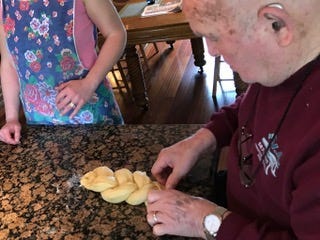
As a young girl, I remember watching him plait bread, carefully braiding and tucking the dough together to form beautiful loaves. He had very large, strong hands and I loved to watch them deftly handle his creations.
Interestingly, though he lost a good deal of intellectual ability, he never lost the ability to braid dough. Mom, my husband, and I would mix the dough; however, he was the braider. Muscle memory kicked in, resulting in beautifully formed loaves ready for the oven.
Since my father’s death in 2019, I have had lots of time to reflect on what helped him as he faced his later years. Certainly, the right medicine was critical to his wellness; however, music soothed his soul and creative practices like painting and baking improved his well-being.
However, it’s more than that.
These seemingly simple creative practices have surprising benefits for the aging brain. By adopting creative practices, research says we can not only improve our emotional state; potentially, we can improve our cognitive function.
We need creativity to increase cognitive preservation.
According to Global Brain Health Institute neuroscientists Carlos Coronel, PhD, and Augustin Ibanez, PhD, “Creative engagement seems to play a role as a protective factor against cognitive decline in the elderly.” The empirical data they gathered from 13 countries showed that creative practice strengthens the coupling between brain regions, improving communication patterns. In their studies, people with a regular, creative practice had more efficient networks, a hallmark of slower aging.
The research is very compelling.
The Global Brain Health Institute advocates for “an increase in creativity as a social prescription and as an intervention across diseases and healthy aging.” Creativity, is a cognitive process that is associated with divergent thinking, a fundamental, and necessary skill for making decisions in the many and varied problems of daily living.
Creativity as intervention. Anyone can take this prescription.
Steven Horvath, a geneticist and biostatistician at UCLA sees the practice of a creative art as a non-pharmacological prescription that enhances brain health because it reduces stress. “What is particularly new to me,” notes Horvath, “is that arts engagement may have comparable effects to physical activity.” Horvath advocates for movement as many experts do, but he reminds us that there is more we can do for ourselves even if we have limited mobility.
Cardiologist Doug Vaughan of Northwestern University says creative activities are often an antidote to stress. Many people use art and music as a way to relax. “When people reduce their long-term stress levels,” he says, “this helps tamp down inflammation, too, which is one mechanism by which the arts may be linked to a slower rate of aging.”
I don’t know if I have my Dad’s brain biology, but I do know that I am aging and am committed to doing what I can do to improve my own brain health. What I learned from my Dad’s experience, I am now applying to my life.
I have always been interested in painting but for many years have not had the time to become a student again to take oil painting classes. When I retired from teaching, I became caretaker for both of my parents. I wanted and needed a way that I could “go inside” and rejuvenate. A friend suggested I take art classes with her.
I needed to find a way to go away without “going away!” So I signed up for classes and I set up a spare bedroom as my “studio” where I cold play. For me, oil painting is escape. It is one way to take a break, and look inward using a new lens.
Painting involves companioning oneself through a process that requires staying in the moment. When I am open to it, I see parts of me emerge that sometimes surprise me.
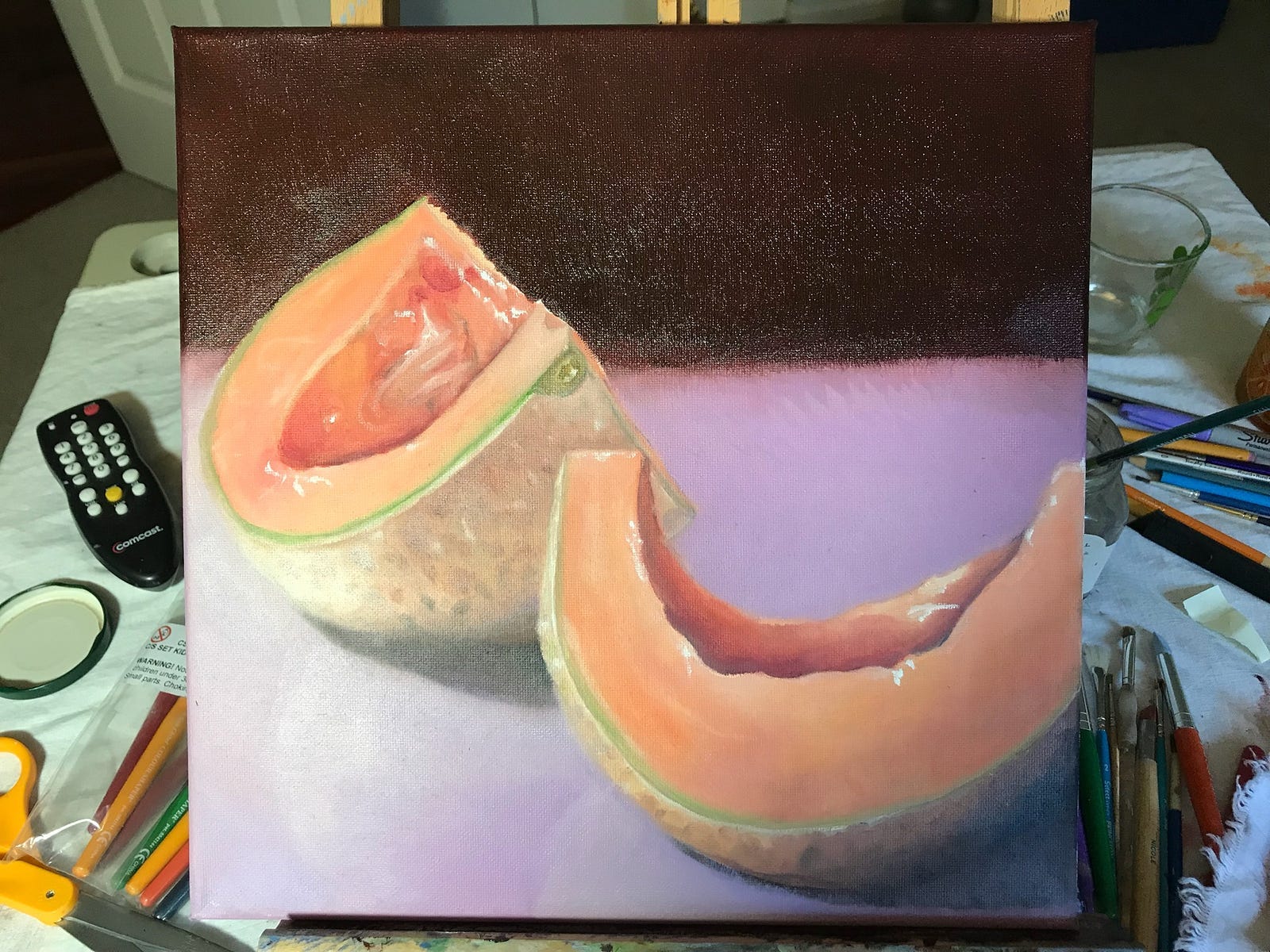
My teacher, Bruce Becker, has the ability to find a student’s skill set and takes that student to the next level of difficulty through his use of modeling, guiding, and affirming. He reminds us that painting is problem-solving. With every step of the process we are making decisions and finding ways to make things work.
If I am understanding the research correctly, any type of creative practice done consistently offers immense benefits. Any creative art works: writing, cooking, building, acting, playing instruments, gardening. What a great perk, right?
There is a stress that can accompany the process of creating. I’m told that, too, is good for my brain. It is just enough challenge to stimulate learning and not too much stress that makes things too difficult to complete. This growth happens regardless of a person’s ability level.
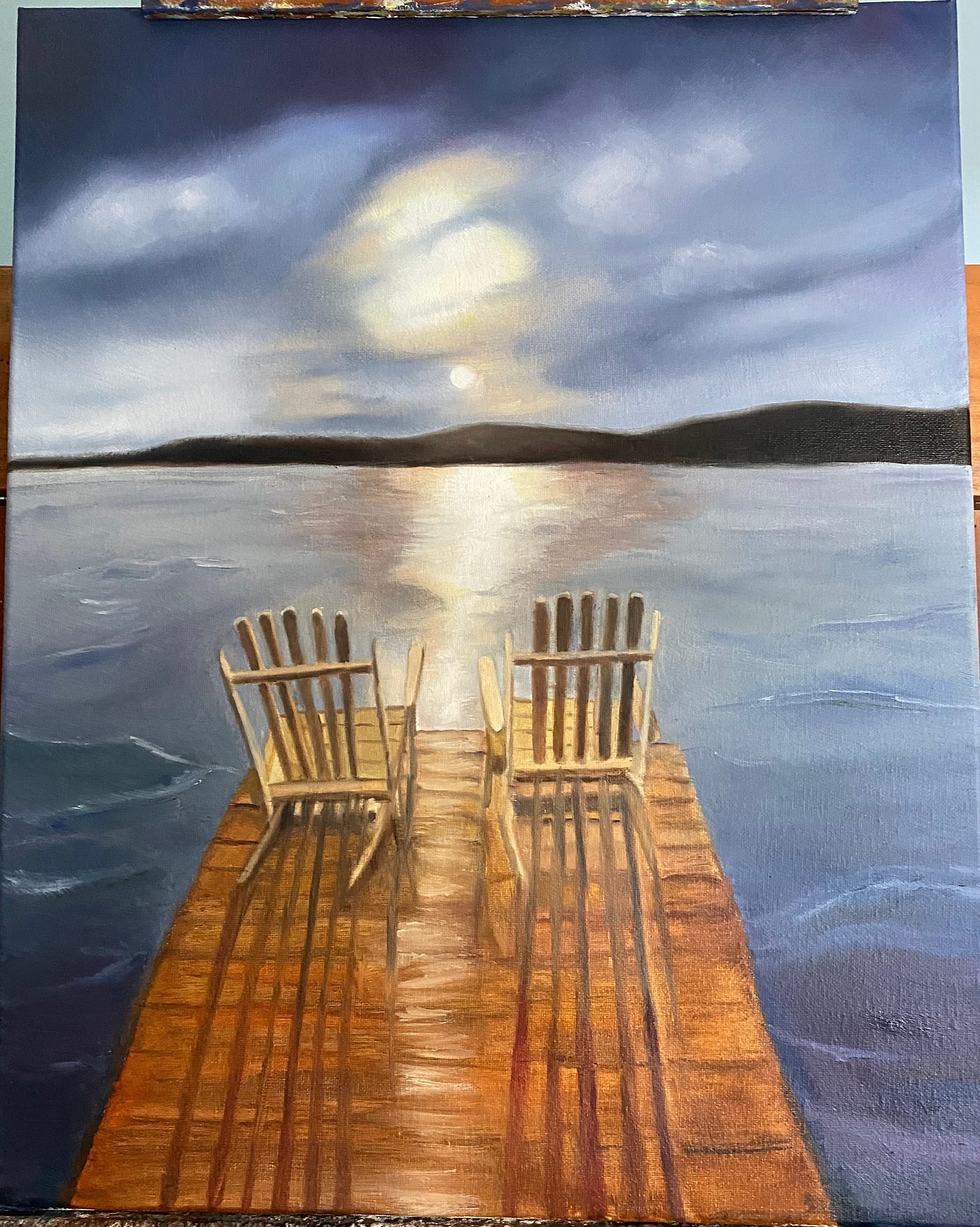
Initially, I hoped to be able to paint something that was beautiful and wished it would have some semblance of realism. Instead, what I found was a way in which I learned about myself.
Painting is an exercise in metacognition for me, a creative practice that helps me understand myself and see the world around me just a bit more clearly.
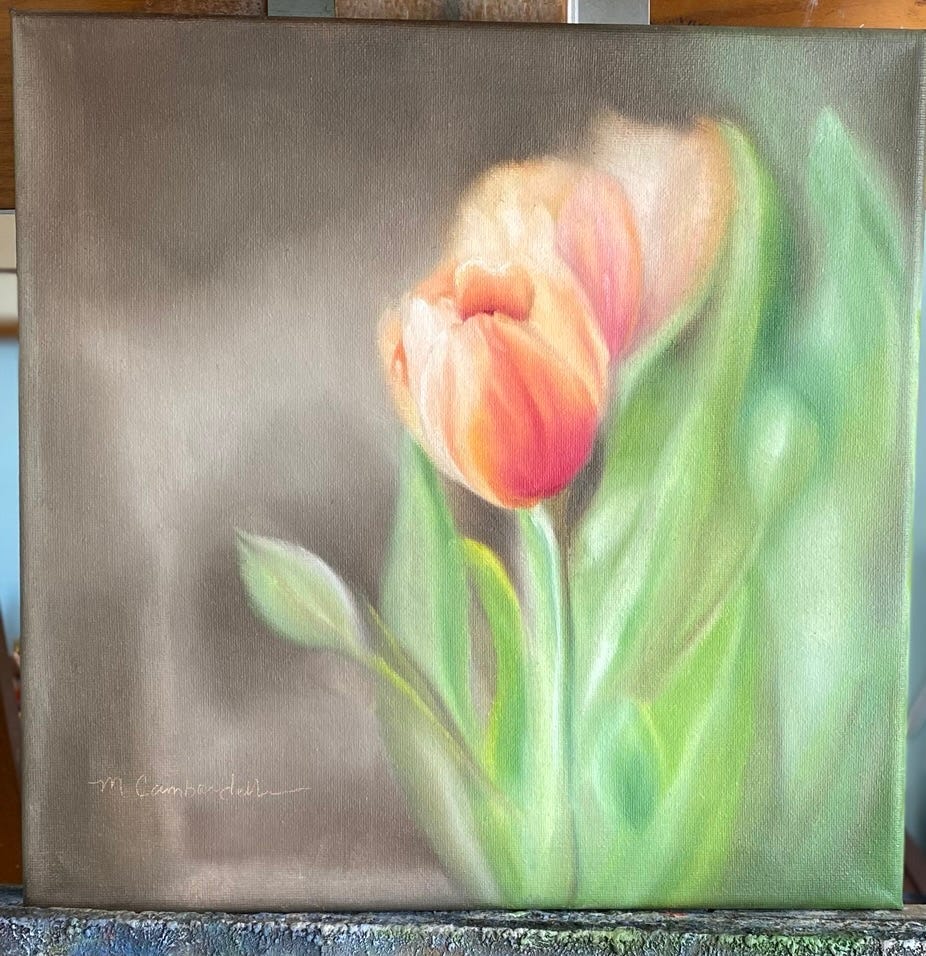
Carving out time, prioritizing a creative practice is of primary importance. I am beginning to understand that it is not a luxury, but a necessity for brain health.
Thankfully, it is one I love.
Beautiful piece… beautiful art and definately something that I want to try.
This statement resonates with me: “Painting involves companioning oneself through a process that requires staying in the moment. When I am open to it, I see parts of me emerge that sometimes surprise me.”
I feel that way about writing or storytelling as well, as I’m sure you do.
Although with writing or storytelling there is an odd duality involved. Thinking about a story I want to tell requires me to put myself somewhere else and sometime else, either through memory or imagination. But the act of writing requires me to be focused and present in the act of creating.